


 русский
 Español
 عربى

Triangle Sign for Car: How to Choose a Warning Triangle That Actually Works
 2026.10.23
 Industry News
Content
- 1 What a Triangle Sign for Car Use Really Does
- 2 When You Should Put It Out
- 3 Placement: The Part Most Drivers Get Wrong
- 4 Reflective, LED, or Solar: Which Warning Triangle Fits Your Driving?
- 5 What to Check Before You Buy
- 6 Where to Store It and How to Keep It Ready
- 7 Built in Yuyao: Our Warning Triangle Range
- 8 Frequently Asked Questions
A triangle sign for car emergencies is one of those small items you hope never leaves its case. Then a tire goes flat on a wet shoulder at dusk, traffic is moving faster than you expected, and that folded piece of plastic suddenly becomes the most important object in the trunk. We build warning triangles for a living, so we think about that moment more often than most people do, and the details that decide whether a triangle works have very little to do with how it looks in a product photo.
This guide walks through what a car warning triangle actually does, when and where to place it, which style suits your driving, and how to keep it ready for the day you need it.
What a Triangle Sign for Car Use Really Does
A warning triangle is a folding, freestanding sign with a red border and retroreflective faces, designed to be seen by drivers approaching your stopped vehicle from behind. It is deliberately simple: no wiring, no switches, nothing to remember except taking it out of its case and setting it down.
The shape carries the message on its own. An upright triangle reads as a caution symbol almost everywhere in the world, so an approaching driver does not have to read a word to understand that something ahead is wrong. What keeps you visible, though, is the reflective film. Retroreflective material returns a headlight beam straight back toward its source, which is why a good triangle appears bright at well over a hundred meters even though it has no power of its own.
In much of Europe and many other markets, a triangle meeting a recognized standard such as UN Regulation No. 27 must be carried in the vehicle. In the United States, warning device rules such as FMVSS 125 apply mainly to commercial vehicles, and requirements vary widely from place to place. Some countries even ask for two triangles in certain vehicles. Treat all of this as a starting point and check the rules where you drive.
When You Should Put It Out
The triangle belongs on the road any time your vehicle becomes an unexpected obstacle. In practice, that covers more situations than most drivers expect:
- A breakdown that leaves you stationary in a live lane or on the shoulder.
- Changing a flat tire, especially on the traffic side of the car.
- After a collision, once everyone is clear of the wreckage.
- Cargo that has fallen onto the road and cannot be moved immediately.
- Heavy fog, torrential rain, or snow that forces you to stop where you would normally never park.
- Any short stop where your hazard lights alone may be hidden by a curve, a hill, or a parked truck.
The triangle does not replace your hazard lights. The two work together: the flashers say "this vehicle is stopped," and the triangle warns drivers while they are still far enough away to slow down and change lanes.
Placement: The Part Most Drivers Get Wrong
Getting the triangle out is easy. Placing it well takes about thirty seconds of thought, and those thirty seconds are the whole point.
- Switch on your hazard lights before you open the door.
- Take the triangle out and walk away from the traffic side of the vehicle whenever the layout allows it.
- Unfold it completely and lock the legs so the base sits flat and cannot tip in a gust of wind or passing draft.
- Set it behind the vehicle at the distance your local rules require. A common benchmark is at least 50 meters on high-speed roads, with shorter distances on city streets and longer ones where visibility is poor.
- If you are stopped on a curve or just over a hill crest, place the triangle where approaching drivers first see it, not directly behind your bumper.
- Stay out of the space between your car and the triangle. That strip is where secondary collisions happen.
- Pick the triangle up only when you are ready to drive away, and fold it as you go.
On a divided highway, the shoulder you use matters as much as the distance. On a two-lane road with blind bends, a little extra distance buys a lot of extra reaction time.
Reflective, LED, or Solar: Which Warning Triangle Fits Your Driving?
All three styles share the same red triangle geometry and the same reflective border. The difference is how they behave when light is scarce and attention is short.
| Style | How it works | Strongest in | What to remember |
|---|---|---|---|
| Reflective folding triangle | Retroreflective faces return headlight beams | Everyday use, day and night | Nothing to charge; keep the faces clean |
| LED flashing triangle | Battery powered LEDs pulse behind the reflective border | Rain, fog, dusk, heavy traffic | Check the batteries before long trips |
| Solar LED triangle | A small panel trickle charges a rechargeable cell | Drivers who park outdoors | Needs daylight; store it where the panel can see light |
A reflective triangle is the dependable baseline, and for many drivers it is all they will ever need. When you regularly drive in rain, fog, or on fast roads at night, a flashing version adds a moving element that catches the eye earlier than a static sign.
 Black Multifunctional Solar LED Car Emergency TriangleFor drivers who want an active flashing alternative to a static reflective triangle, this foldable black model adds LED warning, flashlight, SOS and power-bank functions.View Product →
Whatever the style, the reflective film should be bright and unclouded. A triangle that has spent five summers on a rear parcel shelf may look fine in the garage and disappear in a headlight beam.
What to Check Before You Buy
Price differences between warning triangles are usually small, so it makes sense to compare the details that decide whether the thing survives ten years in a trunk:
- Standard compliance. Look for a triangle that meets the standard recognised in the market where it will be sold or used.
- Base stability. A wide, weighted base with locking hinges stays put on uneven asphalt and in crosswinds.
- Hinge feel. Open and close it a few times. Stiff, positive hinges last; loose ones wobble and eventually refuse to lock.
- Reflective quality. The red border should be uniformly bright, with no patchy or peeling film.
- Power supply. For LED models, check whether the batteries are replaceable or rechargeable and how long a set lasts.
- Case and size. It should fold flat enough to slide under a seat or beside a spare tire, and come with a case that keeps dust off the film.
- Surface finish. Coated and electroplated bodies resist scuffing better than bare plastic if the triangle gets knocked around.
Where to Store It and How to Keep It Ready
The best triangle in the world is useless if you have to unpack half the trunk to reach it. Keep it in an accessible spot near the tailgate, not buried under luggage or camping gear, and make sure everyone who drives the car knows where it lives.
Maintenance is genuinely simple. Wipe the reflective faces with a soft damp cloth when they look dull, keep the hinges free of grit, and replace LED batteries once a year or before a long winter trip. Avoid leaving a folded triangle in direct sun for months at a time, since heat and ultraviolet light slowly degrade plastic hinges and reflective film. A quick check each time you wash the car takes seconds and tells you whether the legs still lock properly.
Built in Yuyao: Our Warning Triangle Range
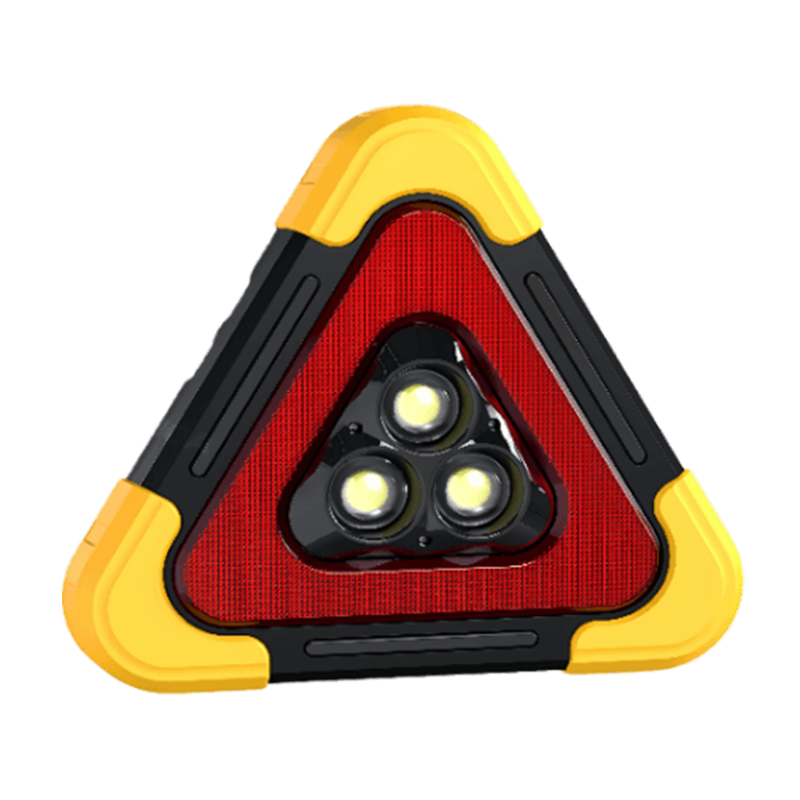
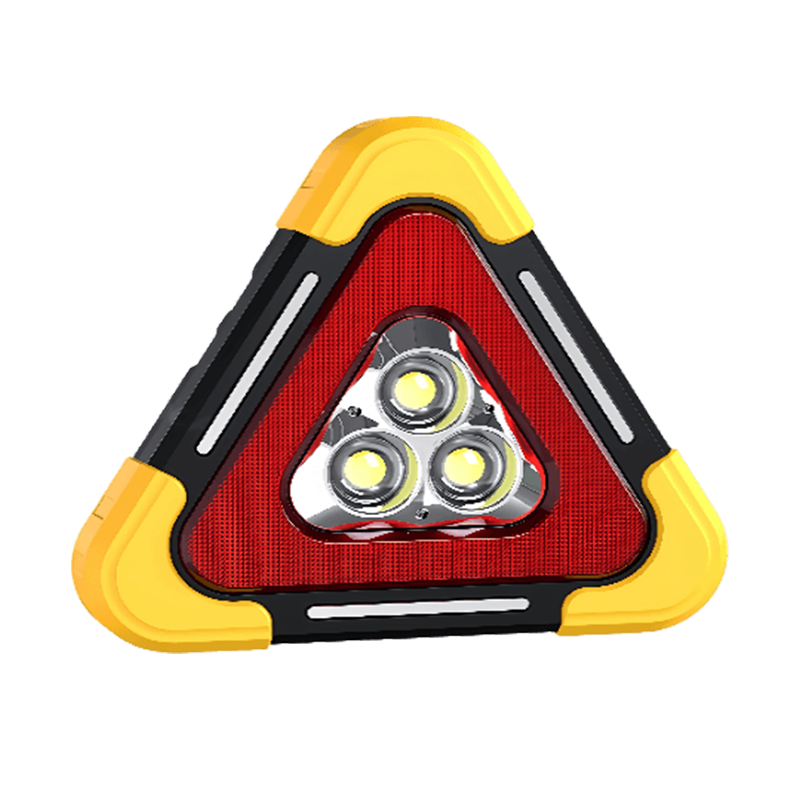
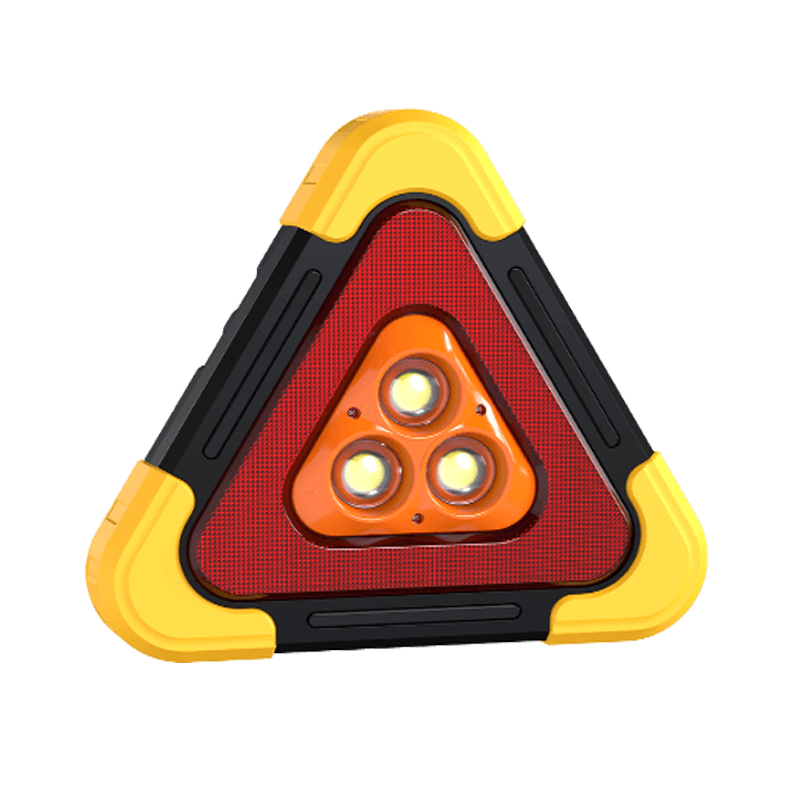
Our SJJD003 family covers four versions of the same folding design. The L1 is a black triangular warning flasher with battery powered LEDs, the L2 uses a silver electroplated finish, the L3 comes in orange, and the L4 wears a silver painted body. The reflective geometry, the locking base, and the folding action are shared across the range; the differences come down to finish, lighting, and packaging.
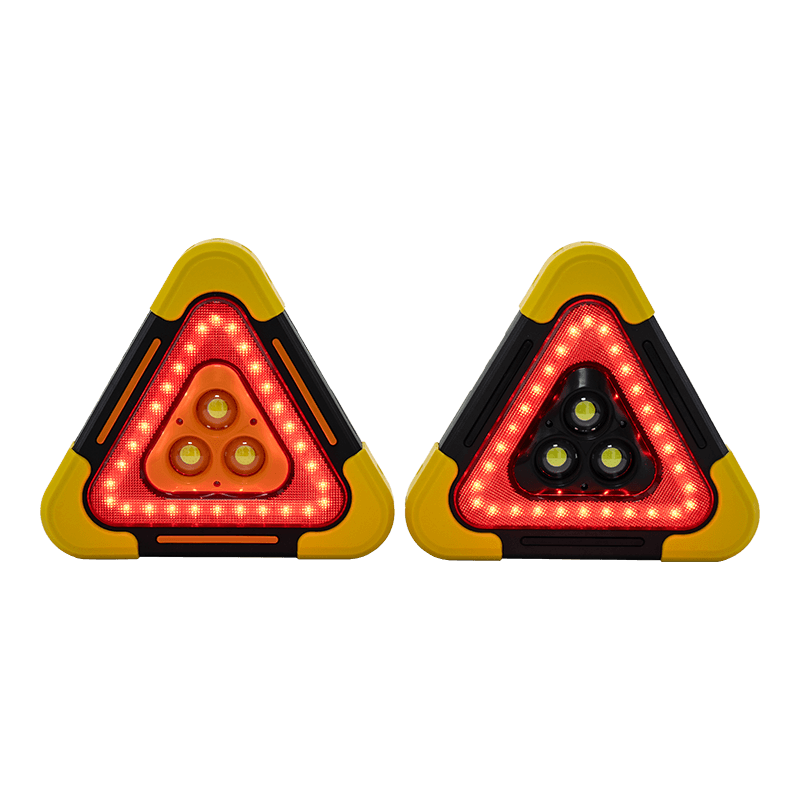 SJJ-D003 Orange LED Solar Rechargeable Warning TriangleThe orange L3 variant provides active long-distance warning with 68 red flashing LEDs, plus solar/USB-C charging and four-in-one emergency, flashlight, SOS and power bank use.View Product →
 Silver Electroplated Multifunctional Solar LED Car Emergency TriangleThe silver electroplated SJJ-D003 offers the shared folding warning design with flashlight, SOS signal and power bank, charged by solar and USB-C for roadside use.View Product →
Because we are a small manufacturer working inside the Yuyao appliance and mould supply chain, we can also adjust colour, logo, packaging, and battery configuration for buyers who need a specific look on the shelf. The triangle sits alongside our car air pumps, cordless mini vacuums, and baby milk shakers in our full product catalogue, which is a useful reminder that roadside safety is one part of a much wider car-care kit.
Frequently Asked Questions
How far behind the car should the triangle go?
It depends on the road. Many countries ask for roughly 50 meters on high-speed roads, shorter distances in built-up areas, and more where sight lines are limited. Always follow the rule that applies where you are driving.
Do I need more than one triangle?
Some countries require two in certain vehicles, and a second triangle is genuinely useful when you are stopped on a curve or towing a trailer. Check your local requirements before you travel.
Is an LED triangle better than a plain reflective one?
Not automatically. A clean reflective triangle is reliable in all conditions and never needs a battery. An LED version adds visibility in rain, fog, and low light, which matters most for drivers who spend a lot of time on fast roads.
A warning triangle is a small purchase with an outsized job: it buys the drivers behind you a few extra seconds to notice, slow down, and move over. Choose one that folds flat, locks firmly, and stays bright, keep it where you can reach it, and check it once in a while. If you are sourcing triangles for a retail chain, an auto-parts distributor, or a private label program, our team would be glad to talk through finishes, packaging, and volumes through our contact page.

Recommended Products
Latest News

Contact Us
LET'S START COLLABORATING
Jialiang Electrical Appliance develops high-quality automotive and household products, including inflators, vacuum cleaners, bottle warmers, and small appliances. We aim to enhance daily life with innovative, user-focused solutions.
Product
Jump Starter and Air Compressor Solar LED Reflective Warning Triangle Light Wireless Mini Vacuum Cleaner Baby Milk Shaker Foam SprayerSTAY CONNECTED
 +86 13956690933
 [email protected]
 No. 67, Mojian Hill, Ditang Street, Yuyao City, Ningbo City, Zhejiang Province, China.
MOBILE
Copyright © Yuyao Jialiang Electrical Appliance Co., Ltd. All Rights
Reserved
 Custom Electric Household Appliances Manufacturers