


 русский
 Español
 عربى

Can LED Lights Catch on Fire? The Real Causes of LED Fire Risk Explained
 2026.10.02
 Industry News
Content
We get this question more often than you might expect, usually right after someone has watched a video of a melted LED strip or a scorched light fitting. The short answer is genuinely reassuring: the diode itself is seldom the problem. An LED has no glowing filament and does not run at the temperatures that made old halogen bulbs such a hazard, so a bare LED is rarely the thing that starts a fire.
The fires blamed on LED lights almost always begin somewhere else in the system the light depends on: the driver, the wiring, the plug, or a battery. Once you know which part is which, the topic stops being frightening and becomes something you can actually manage.
Why LEDs Are Cooler, but Not Risk-Free
An incandescent or halogen bulb turns most of the electricity it uses into heat. Anyone who has brushed against a bulb that had been on for a few minutes knows the feeling. LEDs work differently: they convert a much larger share of the power they draw into visible light, which is why a small LED can replace a much larger bulb and still leave the lampshade cool enough to handle comfortably.
Cooler is not the same as cold. LED chips still generate heat at the junction, and that heat has to travel somewhere, usually through a metal heat sink and then into the surrounding air. If the heat cannot escape, the components around the diode age quickly. The most vulnerable part is usually the driver, the small piece of electronics that converts mains power or 12 V into the steady current the diode needs. Electrolytic capacitors inside a cheap driver dry out, solder joints crack from repeated heating and cooling, and moisture finds its way in through cracks in the housing.
We build LED warning lights for vehicles and small appliances for the home, and both have taught us the same lesson: the light source is the easy part. What surrounds it decides whether a finished product is genuinely safe.
What Actually Causes LED Lights to Catch Fire
When you read reports of LED-related fires, the same handful of causes come up again and again. In most cases, the light itself is a bystander that simply happened to be attached to the failing part.
| What fails | What happens next | How to prevent it |
|---|---|---|
| LED driver or power supply | Capacitors or solder joints overheat; the housing browns and can ignite nearby dust or plastic | Use a correctly rated driver and keep it dry and ventilated |
| Heat management | Junction temperature climbs, the lens yellows, and nearby electronics age fast | Choose fixtures rated for enclosed spaces and never bury them in insulation |
| Wiring and connections | A loose terminal or undersized cable becomes a hot spot | Tighten terminals, match cable to load, inspect old wiring before retrofitting |
| Voltage mismatch | An adapter, plug, or 12 V socket overheats and the plastic softens | Use the correct adapter and avoid daisy-chained splitters |
| Lithium battery packs | Cells swell, and in the worst case they vent or ignite | Charge on a non-flammable surface and replace swollen packs |
| Dust, insects, moisture | Debris creates a conductive path or catches a stray spark | Use IP-rated products in damp areas and clean fittings regularly |
Notice how few of those rows involve the LED emitter itself. That is the pattern worth remembering: the risk lives in the supporting parts, and those parts are exactly what a careless manufacturer trims to save a few cents.
Where the Risk Is Highest in a Car
Vehicles are a hostile environment for any electronic product. A dashboard can reach 70 degrees Celsius or more on a sunny afternoon, and the same cabin vibrates, collects dust, and swings between freezing and baking. Add a 12 V socket that has just run an automotive tire inflator for five minutes, and you have a plug that is already warm before anything else is connected to it.
This is where small faults add up. A plug that does not sit snugly in the socket creates resistance, and resistance creates heat right at the plastic. Stack two or three splitters so you can run a dash camera, a phone charger, and an LED strip at once, and the current passes through several imperfect joints instead of one. Add a cheap LED accessory with thin wires and no fuse, and the weak point is no longer theoretical.
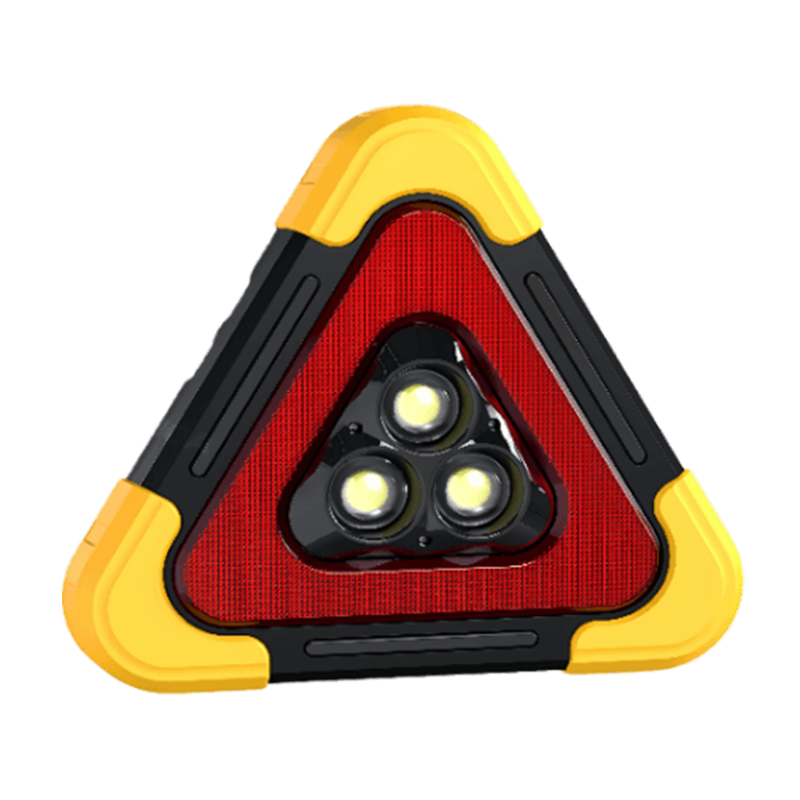
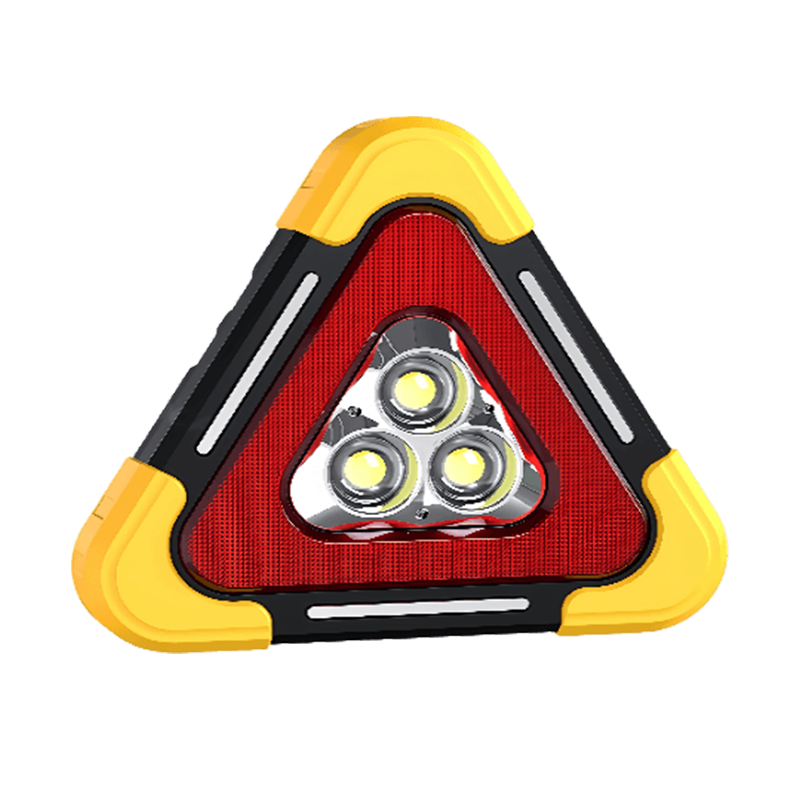
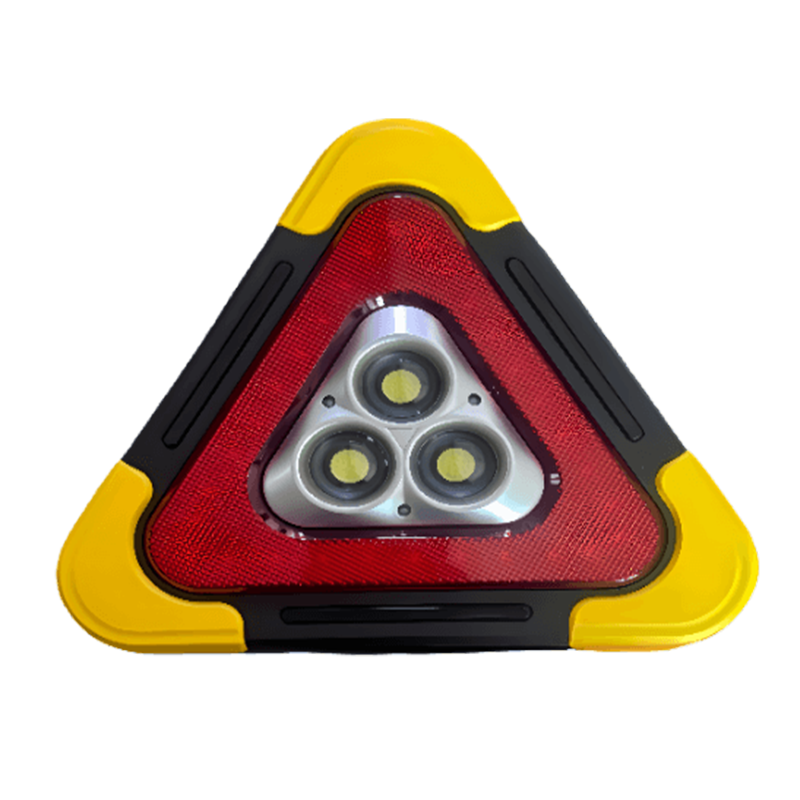
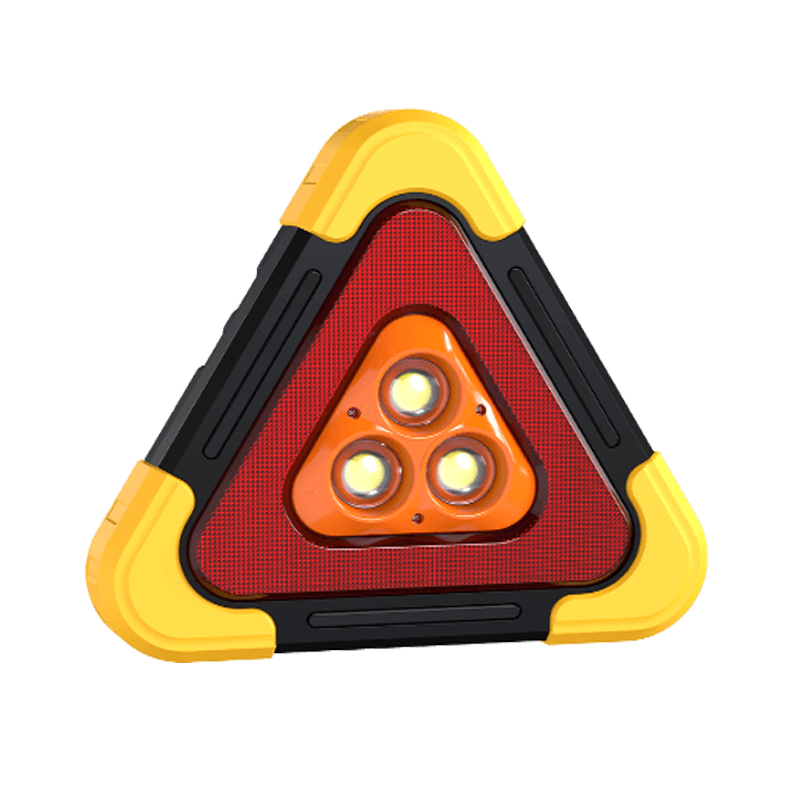
Warning triangles are a good example of how design choices matter. A solar-charged LED triangle that stores its energy in a small internal battery and stays folded in the boot most of the time has far fewer opportunities to fail than a permanently wired accessory running off the vehicle's electrical system.
 GALIANG SJJ-D003 Multifunctional Solar LED Car Emergency TriangleA foldable 4-in-1 roadside safety device combining warning triangle, flashlight, SOS signal, and emergency power bank, with solar and USB-C charging for low-light emergencies.View Product →
If you do use rechargeable LED gear in a car, treat the battery as the part that deserves attention. A device left on a rear parcel shelf through a hot summer is being asked to do something its cells were never designed for.
Warning Signs You Should Never Ignore
Almost every electrical fire gives notice first. These are the signals we would never talk ourselves out of:
- Flickering that gets worse over weeks, or a faint buzzing from the driver
- Brown or yellow discoloration on a lens, housing, or plug
- A hot plastic or burnt smell near a fixture or socket, even if the light still works
- A fitting that is too warm to touch after only a short time in use
- A battery pack that looks puffed or no longer sits flat on a table
- Scorch marks, melted plastic, or black soot around a terminal
Trust your nose and your fingertips here. If something smells wrong or feels hotter than it should, switch it off and unplug it before you start diagnosing.
Simple Habits That Prevent Almost Every LED Fire
- Match the power supply to the product, and never force a plug or adapter to fit.
- Give heat somewhere to go. Do not cover fixtures with insulation and leave a gap around the housing.
- Keep 12 V plugs snug, and stop stacking splitters; every extra joint adds resistance.
- Charge lithium-powered devices on a hard, non-flammable surface, and never leave them in a parked car in summer.
- Replace rather than repair any cheap unit that shows a warning sign. A new one costs less than a claim.
- Check the condition of old wiring before you retrofit LED lamps into an older circuit.
- Buy from a supplier who can explain how the driver and the heat sink are designed, not just how bright the light is.
How We Think About It When We Build LED Products
Working in Yuyao, where the home appliance supply chain is dense and competitive, we have seen both ends of the market. The differences between a safe LED product and a risky one are rarely visible from the outside. They show up in the thickness of the heat sink, the quality of the constant-current driver, the gauge of the wire, and whether anyone bothered to test how a plug behaves after a hundred insertions.
Those are the details we spend our time on. Our warning triangles use solar charging instead of permanent wiring, which removes a whole category of failure before it starts, and the same thinking carries over to the small appliances and automotive accessories we make.
 MSJJ-D003 Solar LED Emergency Triangle with 68 Red LEDsFoldable emergency triangle with 68 high-bright red LEDs, five light modes, solar/USB-C charging, and combined flashlight, SOS, and power bank functions.View Product →
Buyers who ask hard questions about heat, current limiting, and battery chemistry usually end up with fewer complaints from their own customers. If you would like the specifics on any model, including dimensions, packaging options, and how the electronics are protected, our team is glad to walk you through it.
So, can LED lights catch on fire? As a light source, no, not on their own. As a finished product with a driver, a cable, or a battery attached, they can, if one of those parts is cheap, damaged, or misused. The good news is that the same few habits cover almost every scenario: keep connections tight, let heat escape, respect batteries, and take warning signs seriously. Do that, and the LED lights in your home and your car will stay what they were meant to be, which is simply a safer way to light things up.

Recommended Products
Latest News

Contact Us
LET'S START COLLABORATING
Jialiang Electrical Appliance develops high-quality automotive and household products, including inflators, vacuum cleaners, bottle warmers, and small appliances. We aim to enhance daily life with innovative, user-focused solutions.
Product
Jump Starter and Air Compressor Solar LED Reflective Warning Triangle Light Wireless Mini Vacuum Cleaner Baby Milk Shaker Foam SprayerSTAY CONNECTED
 +86 13956690933
 [email protected]
 No. 67, Mojian Hill, Ditang Street, Yuyao City, Ningbo City, Zhejiang Province, China.
MOBILE
Copyright © Yuyao Jialiang Electrical Appliance Co., Ltd. All Rights
Reserved
 Custom Electric Household Appliances Manufacturers